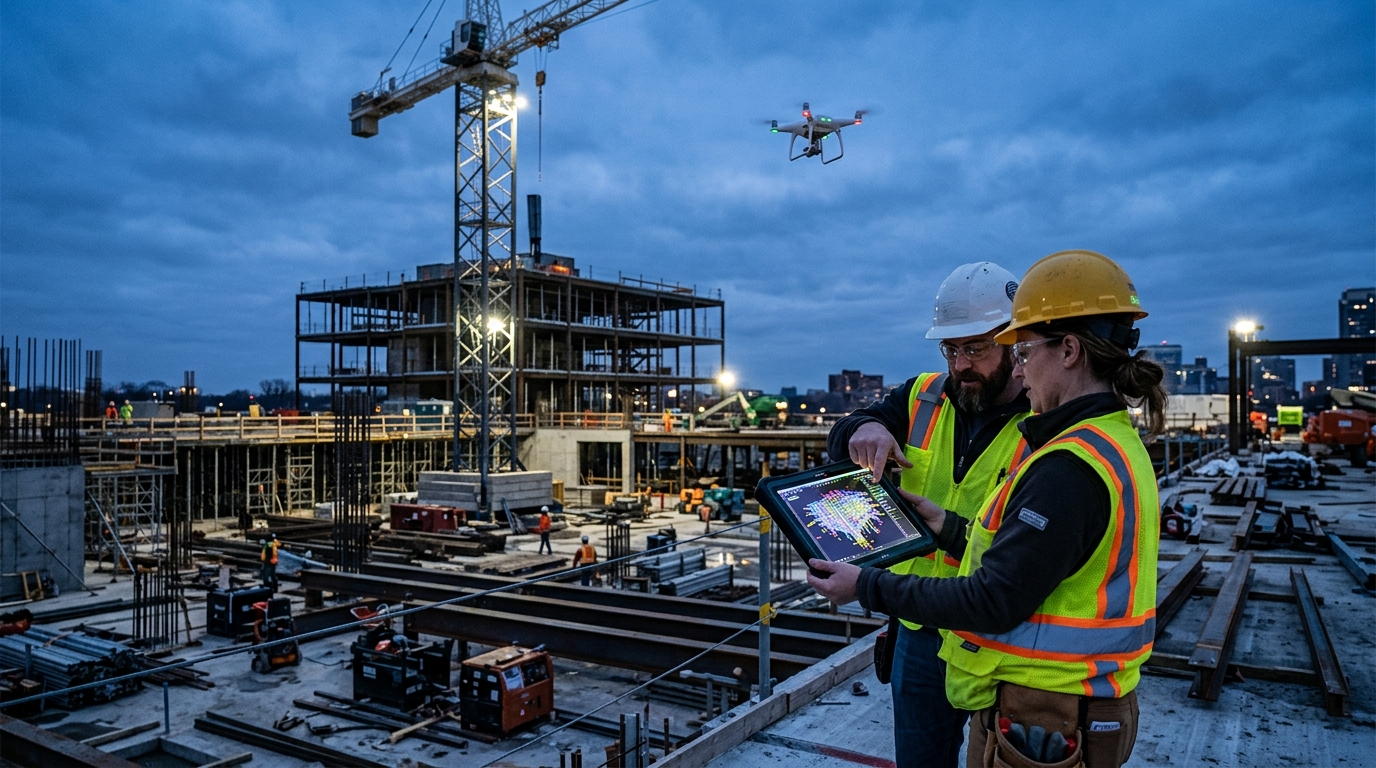
The construction industry has always evolved, but the pace of change happening right now is different. What used to be pilot programs and experimental tools are quickly becoming standard practice on jobsites everywhere. Here’s a look at the biggest construction technology news and trends currently reshaping how projects get built.
From Scattered Tools to Connected Systems
One of the clearest shifts in the industry is contractors moving away from disconnected digital tools and toward integrated systems that link accounting, job costing, payroll, field operations, and project management under one roof. Instead of juggling separate software for each function, firms are consolidating everything into platforms that talk to each other — reducing data silos and giving teams a clearer, real-time picture of a project’s health.
This shift toward connected, AI-powered tools and equipment is moving fast, turning what were once pilot programs into standard industry practice across construction sites.
AI Is Becoming Standard, Not Optional
Artificial intelligence is no longer a novelty in construction — it’s becoming embedded in the everyday software teams already use. Rather than adding entirely new tools on top of existing workflows, companies are focusing on making their current tools smarter, with AI supporting rather than complicating day-to-day operations. The firms that benefit most aren’t necessarily the ones adopting every new tool available, but the ones being deliberate about which technologies actually fit their workflow.
Recent industry developments include AI-powered project data research hubs and major platform updates aimed at large construction owners, reflecting how quickly vendors are releasing new AI-driven products for the sector.
Jobsite Intelligence and Accountability
Documentation and accountability have become major differentiators this year. Owners, insurers, and subcontractors increasingly want documented proof of what happened on a jobsite and when — from verifying subcontractor progress to catching schedule delays before they escalate. This demand for accountability is also showing up in insurance, with some insurers now offering discounts to contractors who use site-monitoring technology to reduce risk.
BIM, Digital Twins, and Smart Infrastructure
Building Information Modeling (BIM) and digital twin technology continue to expand beyond individual buildings. Governments and large developers are increasingly requiring advanced BIM and digital twin capabilities for major infrastructure projects, particularly in transport, energy, and smart city developments. This reflects a broader move from static building models toward living digital systems that generate ongoing data throughout a structure’s lifecycle.
Alongside BIM and digital twins, other leading trends this year include artificial intelligence, augmented and virtual reality, robotics, drones, 3D printing, cloud-based platforms, modular construction methods, and low-carbon construction reporting.
Where the Growth Is Happening
Not all construction sectors are moving at the same speed. Data centers are currently the strongest growth story in the industry, though healthcare, power infrastructure, cold storage, and industrial automation facilities are also drawing significant investment. Data center development in particular is outpacing traditional construction, pushing builders to rely on tools like shared digital planning environments and 3D laser scanning to coordinate teams and catch design conflicts before construction even begins.
As AI keeps embedding itself deeper into industries like construction, it’s worth understanding the basics first — check out our guide, What is AI? The Simplest Explanation You’ll Ever Read, for a clear, jargon-free breakdown
Labor Shortages Are Still Driving Tech Adoption
Much of this technology push isn’t happening in isolation — it’s a direct response to ongoing labor challenges. The industry needs hundreds of thousands of net new workers to keep up with demand, yet the supply of skilled labor continues to lag behind. Recent industry surveys found that a majority of firms expect to grow their headcount this year, while a large share also report serious difficulty filling both hourly and salaried positions. Technology is increasingly being used to close that gap — automating administrative work, improving visibility, and helping smaller teams manage more complex projects without simply adding headcount.
The Bigger Takeaway
Across nearly every recent industry report, one theme keeps surfacing: technology alone isn’t the differentiator anymore — execution is. Buying better software, adding drones, or building a digital twin doesn’t matter much if teams can’t translate that technology into cleaner schedules, safer jobsites, and stronger margins. The construction companies gaining a real edge this year aren’t necessarily adopting every new tool on the market; they’re the ones choosing the right technology deliberately and integrating it into how their teams already work.
Final Thoughts
Construction technology news in 2026 tells a consistent story: the industry is moving from experimentation to execution. AI, connected platforms, BIM, digital twins, and jobsite intelligence tools are no longer edge-case innovations — they’re becoming the baseline for staying competitive. For contractors and industry watchers alike, the real story isn’t just which tools are trending, but which companies are turning them into better-run, more resilient projects.
For more technology and industry news like this, visit the Alpha Magazine homepage.