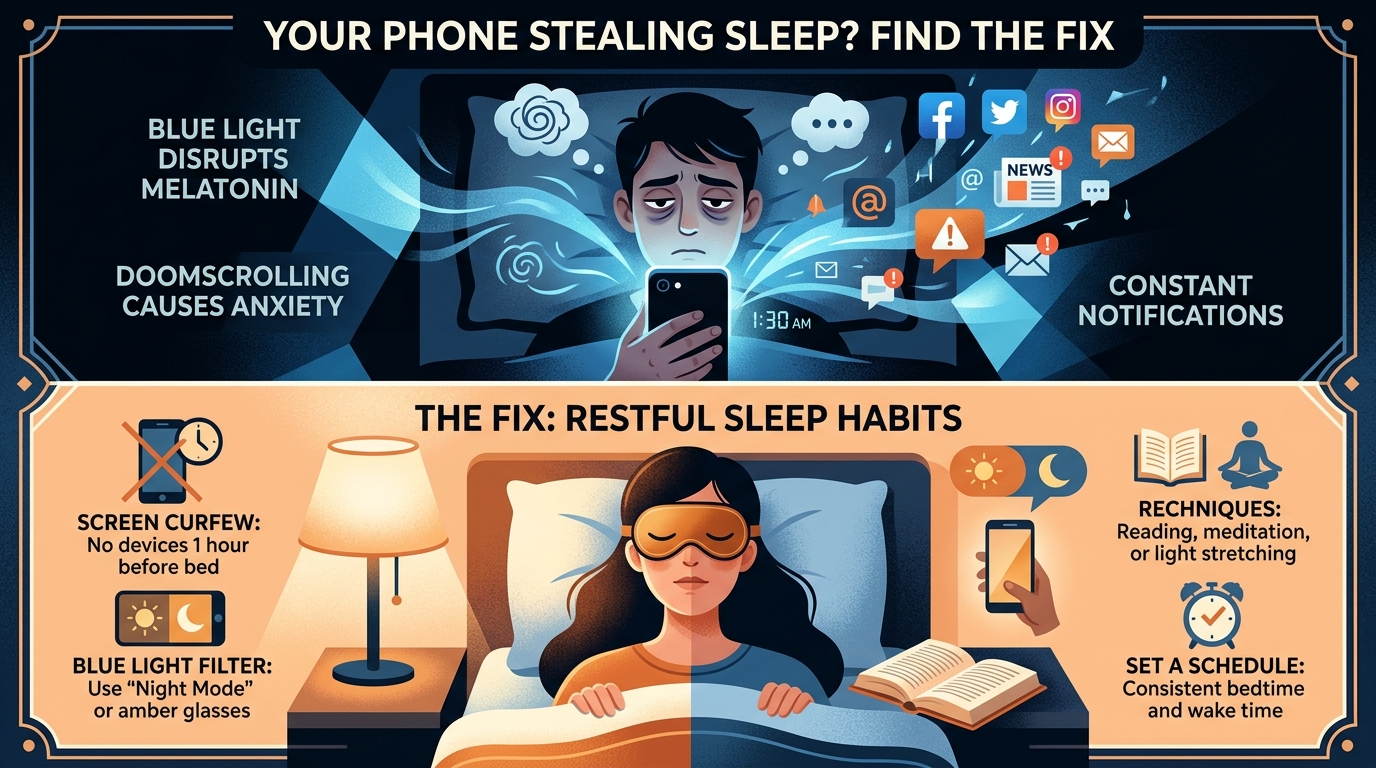
You already know you should put your phone down before bed. Yet here you are, scrolling at midnight, wondering why you cannot sleep. You are not weak — you are up against a billion-dollar industry designed to keep your eyes on that screen.
But here is what most people do not realize: it is not just about willpower. Your phone physically changes your brain chemistry at night, making it biologically harder to fall asleep. The good news? Once you understand what is happening — and follow these six fixes — learning how to sleep better at night becomes much easier than you think.
1. 📵 What Your Phone Actually Does to Your Brain at Night
Your phone screen produces blue light — the same wavelength as midday sunlight. When your eyes absorb it at night, your brain receives a clear signal: it is daytime, stay awake. This shuts down melatonin production — the hormone that makes you feel sleepy.
But blue light is only half the problem. Every notification, every scroll, every video activates your brain’s dopamine system — the same reward circuit triggered by gambling. Your brain stays alert, excited, and waiting for the next hit. By the time you put the phone down, your mind is racing. No wonder sleep feels impossible.
The Fix: Put your phone in another room — not face-down on your nightstand, another room — at least 45 minutes before your target bedtime. Yes, it feels uncomfortable at first. That discomfort is withdrawal. It passes within three days.
2. 🌙 Replace Scrolling With One of These Instead
The problem with “just stop using your phone” advice is that it leaves a gap. Your brain is used to stimulation at that time of night — take it away without a replacement and you will reach for the phone within minutes.
Here are the best phone replacements that actually work:
- Read a physical book — even 10 pages signals your brain to slow down
- Light stretching — releases tension stored in your body from the day
- Write 3 things you are grateful for — shifts your mind from stress to calm
- Listen to soft music or a podcast — audio stimulates less than visual
- Prepare for tomorrow — lay out clothes, write your to-do list, close the day mentally
Pick one and do it every night for a week. You will be surprised how quickly your body starts associating that activity with sleep.
3. ⏰ Set a “Phone Bedtime” — Not Just Your Own
Most people set a bedtime for themselves but never set one for their phone. Your phone stays active all night — notifications buzzing, screen lighting up, apps refreshing in the background. Even if you are not actively using it, your brain stays on low alert waiting for the next ping.
Use your phone’s built-in tools to enforce a hard stop:
- iPhone: Settings → Screen Time → Downtime → set a nightly cutoff
- Android: Settings → Digital Wellbeing → Bedtime Mode → turn on automatically
Set your phone bedtime 45 minutes before your own. Let the apps go to sleep before you do.
4. 🌡️ Fix Your Sleep Environment While You Are At It
Once the phone is out of the equation, your environment matters enormously. Most people sleep in rooms that actively work against good sleep without realizing it.
Three quick fixes that make a big difference:
- Temperature: Keep your room between 16°C and 19°C — your body temperature drops as you fall asleep and a cool room accelerates that process
- Darkness: Even small amounts of light — a charging LED, a streetlight through thin curtains — disrupt melatonin. Use blackout curtains or a sleep mask
- Sound: If noise is an issue, a simple fan creates white noise that blocks irregular sounds far better than earplugs
These three changes combined can add 30 to 60 minutes of deep sleep per night — without changing anything else.
5. 🌬️ The 2-Minute Trick to Fall Asleep Faster
Even after putting the phone down, many people lie awake with their mind still racing. This is where the 4-7-8 breathing technique comes in — and it works surprisingly fast.
Here is exactly how to do it:
- Inhale slowly through your nose for 4 seconds
- Hold your breath for 7 seconds
- Exhale completely through your mouth for 8 seconds
- Repeat this 4 times
The long exhale activates your parasympathetic nervous system — the biological off switch for stress and anxiety. Many people fall asleep before completing all four cycles. It sounds too simple to work. It is not.
6. ☀️ The Morning Habit That Fixes Your Night
Here is the counterintuitive secret most sleep guides miss: what you do in the morning directly controls how well you sleep at night.
Getting bright natural sunlight within 30 minutes of waking up sets your circadian clock. It triggers a timed melatonin release approximately 12 to 14 hours later — meaning morning sunlight at 7 AM programs your brain to feel genuinely sleepy around 9 to 10 PM.
This is why people who spend time outdoors in the morning consistently report better sleep quality than those who stay inside under artificial light. Even 10 minutes outside — a short walk, a cup of tea on the balcony — makes a measurable difference.
Want to build a complete morning routine that also improves your sleep? Read our guide: 7 Morning Habits of Successful People That Will Change Your Life.
The Real Reason This Is So Hard
If you have tried to put your phone down before bed and failed, it is not because you lack discipline. Your phone was engineered by some of the smartest teams on earth specifically to keep you using it. The slot-machine scroll, the notification badges, the autoplay — all of it is designed to exploit your brain’s reward system.
Knowing this changes everything. You are not fighting a bad habit — you are reclaiming your sleep from a product that profits from stealing it. Start with one night. Put the phone in the kitchen. See what happens. Most people sleep better the very first night — and never go back.
Frequently Asked Questions
How long before bed should I stop using my phone?
At minimum, 30 minutes. For best results, 45 to 60 minutes. The longer the gap between screen time and sleep, the faster you will fall asleep and the deeper your sleep will be.
What if I use my phone as an alarm?
Buy a cheap traditional alarm clock — they cost less than a good meal. Using your phone as an alarm is the most common excuse people use to keep it in the bedroom. Remove the excuse entirely.
Does night mode or blue light filter actually help?
It helps slightly — but it does not solve the problem. The mental stimulation from scrolling is just as disruptive as the blue light. Night mode is better than nothing, but it is not a substitute for actually putting the phone down.
How many nights until I notice a difference?
Most people notice improvement within 3 to 5 nights of keeping the phone out of the bedroom. By two weeks, falling asleep faster and sleeping deeper becomes the new normal.
Can AI tools help me track and improve my sleep?
Yes — several free AI-powered apps now analyze your sleep patterns and give personalized recommendations. Read our guide on the Best Free AI Tools in 2026 to find the right ones for you.