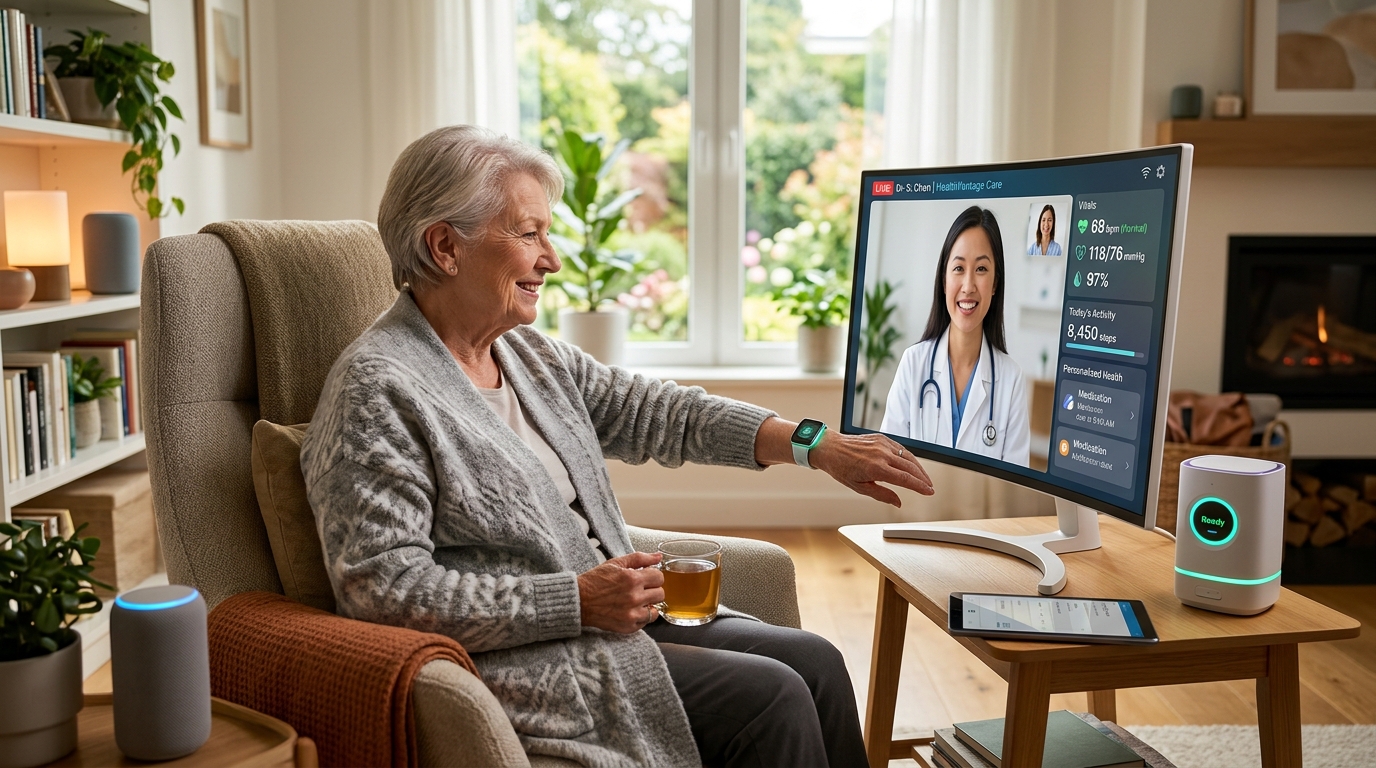
The way we receive medical care is changing faster than most people realize. Thanks to rapid advances in artificial intelligence, wearable devices, and remote monitoring tools, future healthcare technology is elevating at-home care to a level that was unimaginable just five years ago. Patients who once had no choice but to visit hospitals or clinics for routine monitoring can now receive the same quality of care from the comfort of their own homes.
This shift is not just convenient — it is saving lives, reducing costs, and giving patients more control over their own health than ever before.
What is At-Home Healthcare Technology?
At-home healthcare technology refers to medical devices, apps, and AI-powered tools that allow patients to monitor, manage, and even treat health conditions without leaving their homes. These are not simple step-counters or calorie trackers — the latest generation of home healthcare tools can detect irregular heart rhythms, monitor blood oxygen levels in real time, track glucose levels continuously, and send instant alerts to doctors when something unusual is detected.
In 2026, this technology has moved well beyond early adopters and is now reaching mainstream households across the United States and United Kingdom — particularly among elderly patients, those managing chronic conditions, and anyone who has limited access to traditional healthcare facilities.
How AI is Transforming Home Healthcare
Artificial intelligence is at the heart of the home healthcare revolution. Modern AI systems can analyze data collected from wearable devices and home monitoring equipment far faster and more accurately than any human doctor reviewing a weekly report.
Here is what AI-powered home healthcare looks like in practice today. A patient with heart disease wears a small patch on their chest that continuously monitors their cardiac activity. The AI system analyzing that data can detect subtle changes that might indicate an upcoming cardiac event — days before symptoms appear — and automatically alert the patient’s cardiologist. The doctor can then intervene early, potentially preventing a heart attack entirely.
The same principle applies to diabetes management, where continuous glucose monitors connected to AI platforms now provide personalized recommendations for diet, activity, and medication adjustments throughout the day. Patients no longer have to wait for a quarterly appointment to find out their condition is worsening.
If you want to explore the AI tools making this possible, read our guide on the best free AI tools in 2026.
Remote Patient Monitoring — The Fastest Growing Segment
Remote patient monitoring — or RPM — is the practice of collecting health data from patients outside traditional clinical settings and transmitting it securely to healthcare providers. It is the fastest growing segment of home healthcare technology in 2026, and for good reason.
The benefits are significant for both patients and the healthcare system as a whole. Hospital readmissions — one of the most expensive problems in modern healthcare — are reduced dramatically when patients are monitored continuously at home after discharge. Studies in both the US and UK have shown that RPM programs can reduce hospital readmissions by up to 50 percent for patients with chronic conditions such as heart failure, COPD, and diabetes.
For elderly patients living alone, remote monitoring provides an additional layer of safety that family members and caregivers find invaluable. Fall detection devices, emergency response systems, and cognitive monitoring tools are giving older adults the ability to live independently for longer — which is both their preference and significantly less expensive than institutional care.
Telehealth and Virtual Consultations
Perhaps the most visible change in home healthcare over the past several years has been the normalization of telehealth — video and phone consultations with doctors, specialists, and mental health professionals conducted entirely online.
What began as a necessity during global health disruptions has become a permanent and preferred option for millions of patients. In 2026, telehealth platforms have matured significantly. Patients in rural areas of the United States who previously had to travel hours for specialist appointments can now consult with world-class specialists via their smartphones. UK patients facing long NHS waiting times can access private telehealth consultations at a fraction of the cost of traditional private healthcare.
The integration of telehealth with home monitoring devices has created a genuinely new model of care — one where the doctor has access to weeks of continuous health data before the consultation even begins, making the appointment far more productive and personalized than a standard ten-minute office visit.
What This Means for the Future of Healthcare
The direction is clear. Healthcare is moving out of hospitals and into homes, and technology is making that possible without compromising — and in many cases improving — the quality of care patients receive.
For patients, this means more convenience, more control, and earlier intervention when something goes wrong. For healthcare systems in the US and UK, it means reduced costs, fewer unnecessary hospitalizations, and the ability to serve more patients with the same resources. For technology companies, it represents one of the largest growth markets of the next decade.
The home is becoming the most important healthcare setting of the 21st century — and the technology transforming it is only getting started.
Frequently Asked Questions
Q: What is the best at-home health monitoring device in 2026? A: The best device depends on your specific health needs. For heart health, continuous cardiac monitors are the most advanced option. For diabetes, continuous glucose monitors connected to AI platforms offer real-time insights. Smartwatches from major technology companies now include medical-grade sensors for general health monitoring.
Q: Is at-home healthcare technology accurate? A: Modern at-home healthcare devices have reached clinical-grade accuracy for many measurements. Continuous glucose monitors, cardiac monitors, and blood pressure devices approved by health regulators in the US and UK meet the same accuracy standards as hospital equipment.
Q: How does remote patient monitoring work? A: Remote patient monitoring uses wearable devices or home sensors to collect health data — heart rate, blood pressure, glucose levels, oxygen saturation — and transmits that data securely to a healthcare provider’s platform. Doctors and nurses can review the data in real time and contact the patient if anything requires attention.
Q: Is telehealth covered by insurance in the US and UK? A: In the United States, most major insurance providers now cover telehealth consultations following their expansion during the pandemic. In the UK, telehealth is available through both the NHS and private providers. Coverage and availability vary by provider and location.
Q: Who benefits most from at-home healthcare technology? A: Elderly patients, those managing chronic conditions, people in rural or underserved areas, and patients recovering from surgery or hospitalization benefit most. However, the technology is increasingly relevant for anyone who wants more proactive and convenient access to healthcare.