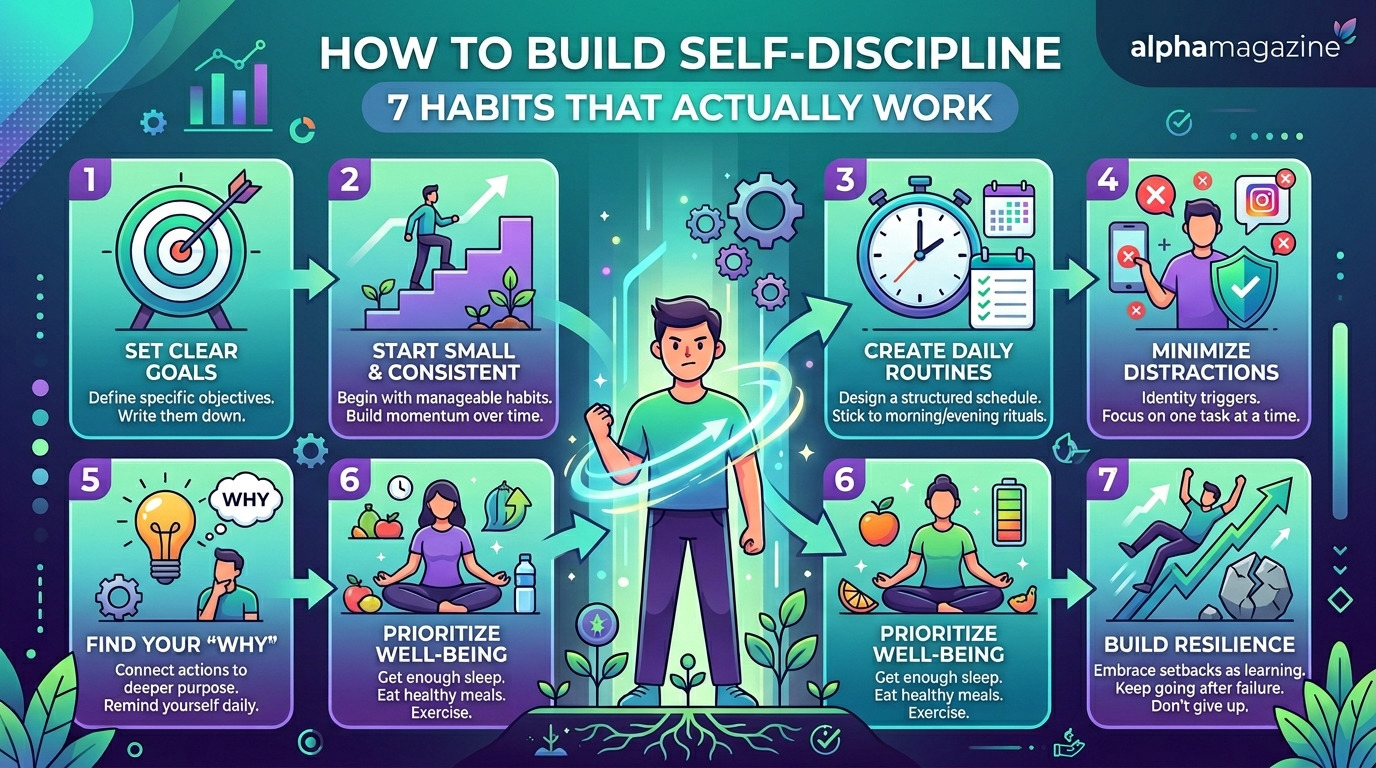
Self discipline is not something you are born with. It is a skill — and like any skill, it can be learned, practised, and strengthened over time. If you have ever set a goal and failed to follow through, started a habit and abandoned it within a week, or found yourself endlessly scrolling instead of doing what actually matters, you are not broken. You simply have not built the systems that make discipline automatic.
These seven habits will change that.
What Self Discipline Actually Means
Most people misunderstand self discipline. They think it means forcing yourself to do things you hate through sheer willpower. That model does not work — willpower is a limited resource that depletes throughout the day.
Real self discipline is about designing your environment, your routines, and your mindset so that the right actions become the path of least resistance. The most disciplined people in the world do not rely on motivation. They rely on systems.
- Start Smaller Than You Think You Should
The biggest mistake people make when trying to build self discipline is starting too big. They decide to wake up at 5 AM, exercise for an hour, meditate, journal, and eat perfectly — all on day one. Within three days, they quit everything.
Start so small it feels almost embarrassing. Want to build a reading habit? Read one page per day. Want to exercise more? Do five minutes. The goal at the beginning is not results — it is proving to yourself that you can show up consistently. Consistency at a small scale is the foundation everything else is built on.
- Remove Temptation From Your Environment
Discipline becomes dramatically easier when you engineer your environment to support the behaviour you want. If your phone is on your desk, you will check it. If junk food is in your kitchen, you will eat it. If social media apps are on your home screen, you will scroll.
Remove the friction from good habits and add friction to bad ones. Put your phone in another room when you need to focus. Delete apps that waste your time. Prepare your workout clothes the night before. These small environmental changes reduce the need for willpower entirely.
- Use Implementation Intentions
Vague intentions fail. “I will exercise more” is not a plan — it is a wish. Implementation intentions are specific: “I will exercise at 7 AM on Monday, Wednesday, and Friday in my living room for 20 minutes.”
Research consistently shows that people who plan exactly when, where, and how they will perform a behaviour are significantly more likely to follow through than those who rely on general intention. Be specific. Write it down. Treat it like an appointment you cannot miss.
- Build Identity Before Outcomes
Most people try to change their behaviour before changing how they see themselves. They say “I am trying to become a disciplined person” rather than “I am a disciplined person.” That distinction matters enormously.
Every action you take is a vote for the type of person you want to become. When you complete a workout, you cast a vote for being someone who exercises. When you write for 20 minutes, you cast a vote for being a writer. Focus on becoming the person first — the results follow naturally.
- Use the Two Minute Rule
If a task takes less than two minutes, do it immediately. If a habit feels impossible to start, scale it down to something that takes two minutes. Reply to that email. Do two push-ups. Write one sentence. Open the book.
The two minute rule works because starting is the hardest part. Once you begin, momentum takes over and you almost always continue beyond the initial two minutes. The barrier is not duration — it is initiation.
- Protect Your Morning
The first hour of your day sets the tone for everything that follows. Disciplined people guard their mornings fiercely. They avoid checking their phone immediately upon waking. They do not start the day in reactive mode — responding to other people’s emails and notifications before they have done anything for themselves.
Use the first hour for something that moves you forward — exercise, reading, planning, or focused work. This single habit has more impact on long-term self discipline than almost anything else. If you want a complete morning routine to pair with this, read our guide on the seven morning habits of successful people.
- Review and Adjust Weekly
Self discipline without feedback is just blind effort. Every week, take ten minutes to review what worked, what did not, and why. Were there specific times of day when your discipline broke down? Specific triggers that led you off track?
This weekly review is not about judging yourself — it is about gathering information. The goal is to understand your patterns so you can adjust your systems. Over time, this process of continuous refinement is what separates people who make permanent change from those who repeat the same cycles indefinitely.
The Truth About Self Discipline
Building self discipline is not a dramatic transformation that happens overnight. It is a slow accumulation of small, consistent choices that compound over months and years. The person with extraordinary self discipline today simply made slightly better choices than everyone else — consistently, over a long period of time.
Start with one habit from this list. Do it for 21 days without exception. Then add the next one. That is it. That is the entire system.
Frequently Asked Questions
Q: Can self discipline be learned or is it genetic? A: Self discipline is primarily a learned skill, not a fixed personality trait. Research in behavioural psychology consistently shows that environment, habits, and systems have far more influence on disciplined behaviour than genetics or innate personality.
Q: How long does it take to build self discipline? A: There is no fixed timeline, but most people notice meaningful improvement within 21 to 30 days of consistent practice. Significant, lasting change typically takes three to six months of deliberate effort and system building.
Q: What is the difference between motivation and self discipline? A: Motivation is an emotion — it comes and goes unpredictably. Self discipline is a system — it operates regardless of how you feel. Relying on motivation means you only work when you feel like it. Building self discipline means you work whether you feel like it or not.
Q: What should I do when I fail at my discipline goals? A: Missing once is an accident. Missing twice is the start of a new habit. When you fail, the only rule is never miss twice in a row. Get back on track immediately without excessive self-criticism. Perfectionism is the enemy of consistency.
Q: Is self discipline the same as willpower? A: No. Willpower is a short-term mental resource that depletes with use. Self discipline is a long-term system of habits and environmental design that reduces the need for willpower entirely. The goal is to make disciplined behaviour automatic — not to constantly fight yourself.