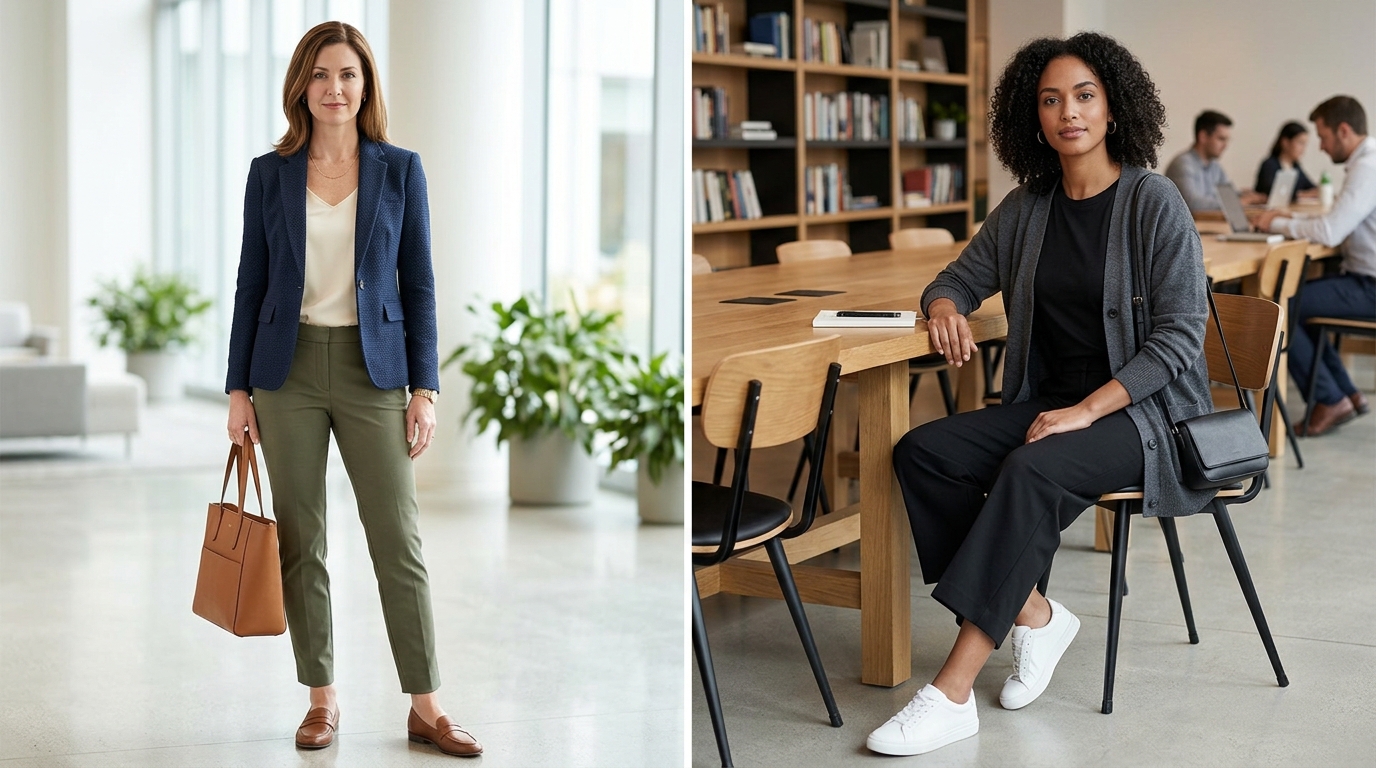
Finding the right business casual outfits for women is one of the most practical style challenges in modern professional life. The dress code sits in an ambiguous middle ground — more relaxed than formal corporate attire but more polished than everyday casual wear — and navigating it successfully requires understanding both what works for your workplace and what works for your body.
This guide covers the essential business casual pieces every professional woman should own, how to dress for your specific body type, and the styling principles that make the difference between looking put-together and looking like you are not sure what the dress code means.
What Business Casual Actually Means for Women
Business casual for women is widely misunderstood because it means different things in different industries and workplaces. In a law firm or financial institution, business casual typically means tailored trousers or a midi skirt with a blouse and blazer. In a creative agency or tech company, it might mean well-fitted jeans with a smart top and clean footwear.
The safest working definition is this: business casual should look intentional, polished, and appropriate for a professional environment — without requiring a full suit or formal dress. Clothes should be clean, well-fitted, and free of casual elements such as graphic prints, ripped fabric, or overly revealing cuts.
When in doubt about your specific workplace, observe what the most senior women in your organisation wear on non-client days. That is your benchmark.
Business Casual Essentials Every Woman Should Own
A well-fitted blazer is the single most versatile piece in a business casual wardrobe. It instantly elevates almost any outfit — worn over a simple blouse and trousers, over a dress, or even over a smart T-shirt. Invest in one well-made blazer in a neutral colour — navy, black, camel, or grey — and it will serve you across dozens of outfit combinations.
Tailored trousers in a straight or wide-leg cut are the most reliable business casual bottom. They are more polished than jeans, more comfortable than a pencil skirt for long working days, and available at every price point. Mid to high waist cuts are the most flattering across body types and pair well with both tucked and untucked tops.
A selection of quality blouses in neutral and muted tones forms the foundation of most business casual outfits. Silk or satin finish blouses look more premium and photograph better than cotton alternatives. Solid colours and subtle patterns are more versatile than bold prints.
Midi dresses and skirts hit at or below the knee and are one of the easiest business casual options available. A well-cut midi dress in a solid colour requires minimal styling effort and looks polished with very little effort. Pair with a blazer and low heels or clean flats for a complete business casual look.
Clean, simple footwear ties a business casual interview outfit together. Block-heeled mules, pointed-toe flats, loafers, and low ankle boots are all appropriate. Stilettos are too formal for most business casual settings. Trainers should be reserved for very casual office cultures only.
How to Dress for Your Body Type
Understanding your body type is one of the most practical style tools available. The goal is never to hide or disguise your shape — it is to choose cuts and proportions that create a balanced, elongated silhouette that looks confident and intentional.
For petite women, proportion is the primary consideration. Cropped blazers that hit at the natural waist create length in the leg. High-waisted trousers elongate the lower body. Monochromatic outfits — the same or similar tones from top to bottom — create an unbroken vertical line that adds visual height. Avoid oversized cuts that overwhelm a smaller frame.
For tall women, the world of business casual is largely open. Long blazers, wide-leg trousers, and midi skirts all work beautifully on a taller frame. The main consideration is proportion — ensure that cropped styles sit at the right point on your torso and that trouser lengths are correct rather than falling short.
For hourglass body types, the goal is to maintain the natural waist definition that is your key asset. Belted blazers, wrap dresses, and fitted blouses tucked into high-waisted trousers all achieve this. Avoid boxy, unstructured cuts that obscure your waist and add visual bulk where you do not want it.
For pear-shaped body types — wider at the hips than the shoulders — the styling principle is to balance proportions by drawing attention upward. Statement blouses, structured blazers with shoulder detail, and darker tones on the lower half all achieve this balance. Wide-leg trousers skim the hip and thigh more flatteringly than straight cuts.
For apple-shaped body types — where weight sits more in the midsection — the goal is to create definition at the waist and draw attention to your best features. V-neck blouses elongate the neckline. A-line skirts and dresses create shape through the lower body. Structured blazers worn open give a defined silhouette without constriction.
Colour and Pattern in Business Casual Outfits
Neutral tones — navy, black, grey, camel, cream, and white — form the most versatile business casual wardrobe foundation. These colours work with each other, are appropriate in any professional setting, and photograph well for video calls and presentations.
Once you have a neutral wardrobe base, introduce colour through accent pieces — a blouse in a muted burgundy, a blazer in a dusty green, or accessories in a warm terracotta. These additions add personality without sacrificing professionalism.
Patterns work in business casual settings when they are subtle — small checks, fine stripes, and tonal prints are all appropriate. Large, bold patterns require more careful styling and can dominate an outfit rather than complement it.
If you want to find great deals on building your business casual wardrobe, check out our guide on the best free AI tools several apps now offer personalized shopping recommendations and outfit planning at no cost.
Frequently Asked Questions
Q: What is the difference between business casual and smart casual for women? A: Business casual is specifically oriented toward a professional workplace context — it assumes an office environment and professional interactions. Smart casual is broader and includes social settings. Business casual is generally slightly more formal than smart casual, with less room for denim, trainers, or casual separates.
Q: Can women wear jeans for business casual? A: In some workplaces, yes — particularly in technology, creative, and startup environments. Dark wash, well-fitted jeans with a blazer and smart footwear can work in these contexts. In more traditional professional settings such as finance, law, or corporate environments, jeans are generally not appropriate for business casual.
Q: What shoes are appropriate for business casual outfits? A: Block heels, loafers, pointed-toe flats, ankle boots, and mules are all appropriate for business casual. The key is that footwear should look clean, intentional, and professional. Avoid overly casual trainers, flip flops, or very high stilettos.
Q: How do plus size women dress business casual? A: The same principles apply regardless of size — proportion, fit, and intentionality are the key factors. Well-fitted tailored trousers, wrap dresses that define the waist, and structured blazers are flattering across all body types and sizes. Avoid clothes that are too tight or too loose — proper fit is always the priority.Q: How many business casual outfits do I need? A: A functional business casual wardrobe can be built around five to seven core pieces that mix and match across multiple combinations. Focus on quality over quantity — three pairs of trousers, four blouses, two blazers, and two pairs of shoes can create over twenty distinct outfits.