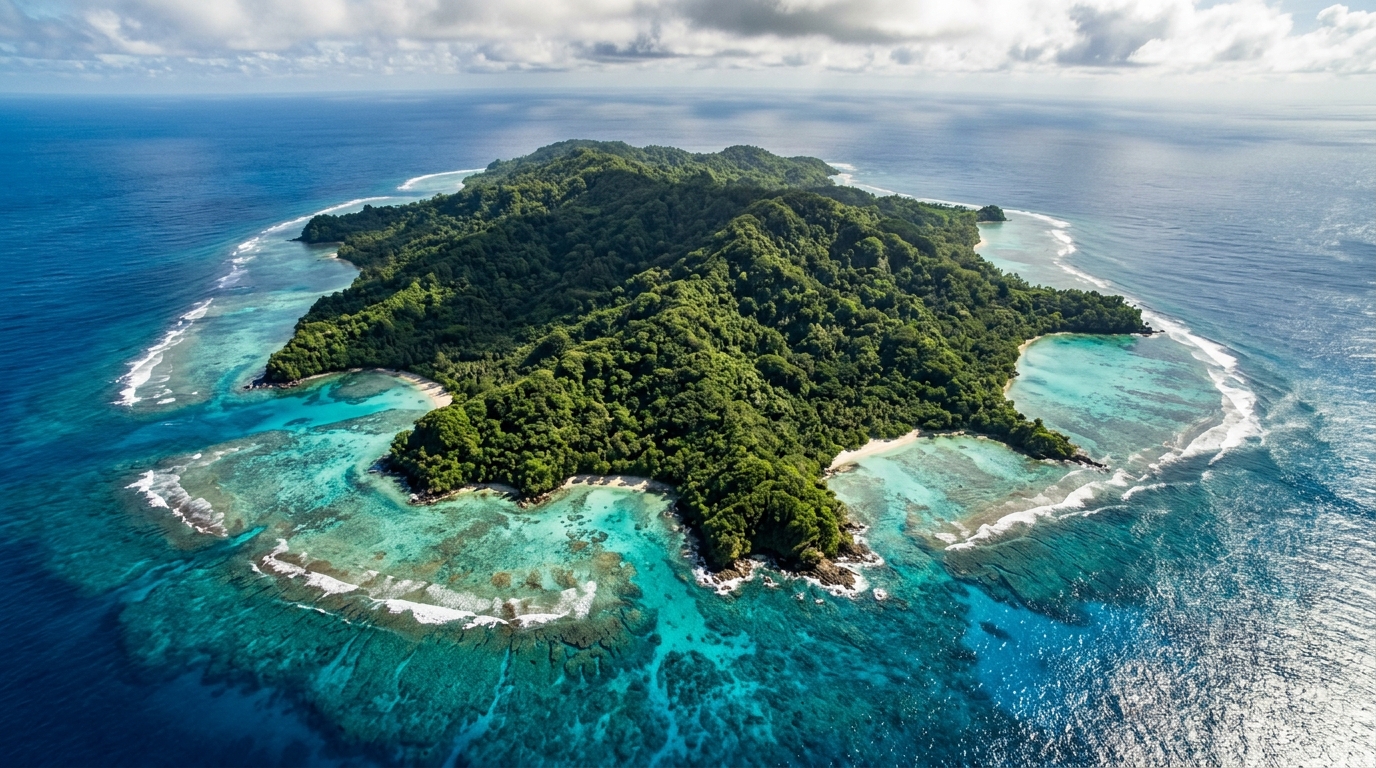
North Sentinel Island is one of the most fascinating, mysterious, and genuinely dangerous places on the entire planet. Located in the Bay of Bengal as part of India’s Andaman and Nicobar Islands archipelago, this small densely forested island is home to the Sentinelese — one of the last remaining uncontacted peoples on earth who have lived in complete isolation from the outside world for an estimated 60,000 years. North Sentinel Island captivates the global imagination precisely because it represents something almost impossible to find in our hyper-connected modern world — a place and a people who have chosen, fiercely and sometimes violently, to remain completely apart from the rest of human civilization.
Where Is North Sentinel Island?
North Sentinel Island is located in the Andaman Sea, approximately 50 kilometres west of South Andaman Island and around 1,200 kilometres from the Indian mainland. The island covers approximately 59.67 square kilometres and is surrounded by a shallow coral reef that makes approach by large vessels extremely difficult — a natural defensive barrier that has helped protect the Sentinelese from outside contact throughout their extraordinary history.
The island is densely covered with tropical forest that extends almost to the shoreline, with no visible infrastructure, roads, or permanent structures visible from the ocean or aerial observation. The interior of the island remains almost entirely unknown to the outside world, as no authorised scientific expedition has ever successfully made peaceful contact with the Sentinelese or explored the island’s interior with their cooperation.
North Sentinel Island is officially part of the South Andaman administrative district of India. The Indian government has maintained a strict exclusion zone around the island since 1996, prohibiting all vessels from approaching within three nautical miles of the shoreline. Violating this exclusion zone is a criminal offence under Indian law — a regulation that exists primarily to protect the Sentinelese rather than to restrict outside visitors.
Who Are the Sentinelese?
The Sentinelese are the indigenous inhabitants of North Sentinel Island and are considered one of the last truly uncontacted peoples remaining on earth. Their population is unknown — estimates range from as few as 50 individuals to as many as 500, though most anthropologists believe the true number is likely between 50 and 150 people based on observations made during authorised contact attempts in the 1990s.
The Sentinelese are believed to be direct descendants of the first human populations to migrate out of Africa approximately 60,000 years ago, making their genetic and cultural lineage one of the oldest continuous human populations on the planet. Their language is completely unknown and unrelated to any documented linguistic family — no outside researcher has ever been able to study or document it due to the complete absence of successful peaceful contact.
Based on observations from authorised contact attempts and aerial surveys, the Sentinelese appear to live as hunter-gatherers, subsisting on fish, wild plants, honey, and animals from the forest. They are observed using bows and arrows, spears, and metal tools — the metal almost certainly salvaged from shipwrecks on the surrounding reef rather than produced through their own metallurgy.
Their society appears to be organised in small family or kinship groups, and they demonstrate extraordinary territorial awareness and defensive capability that has successfully repelled every attempted contact or intrusion for centuries.
The History of Contact Attempts with North Sentinel Island
The history of contact attempts with North Sentinel Island is a remarkable story of repeated rejection spanning several centuries:
Early recorded encounters — The earliest documented Western contact with North Sentinel Island occurred in 1867 when the merchant vessel Nineveh ran aground on the reef. The surviving crew who reached shore were attacked by the Sentinelese and only rescued by a Royal Navy vessel several days later. This early encounter established the pattern of hostile rejection that would characterise virtually every subsequent contact attempt.
The Portman expeditions — In the 1880s and 1890s, British colonial administrator Maurice Vidal Portman led several expeditions to North Sentinel Island. On one occasion his team captured six Sentinelese — two elderly adults and four children — and brought them to Port Blair. The elderly adults quickly fell ill and died. The children were returned to the island with gifts. This deeply troubling episode almost certainly contributed to the Sentinelese people’s enduring hostility toward outsiders.
Indian government contact attempts — Following Indian independence, the Indian government made a series of authorised contact attempts throughout the 1960s, 1970s, and 1980s, approaching by boat and leaving coconuts, pigs, and other gifts on the beach. These attempts met with a range of responses from cautious observation to immediate armed hostility.
The Pandit expeditions — Indian anthropologist Triloknath Pandit led the most successful contact attempts in the late 1980s and early 1990s, managing several brief and relatively peaceful interactions in which gifts were accepted and no violence occurred. These remain the closest any outsiders have come to peaceful contact with the Sentinelese. However, even these encounters were entirely on the Sentinelese’s terms — they approached the boats when they chose to and retreated when they chose to.
The 1996 decision — Following the apparent success of the Pandit expeditions, the Indian government made the landmark decision in 1996 to cease all active contact attempts and establish the three nautical mile exclusion zone. The reasoning was that the potential harm to the Sentinelese from disease exposure and cultural disruption far outweighed any benefits of contact.
The John Allen Chau Incident
The most internationally publicised recent event related to North Sentinel Island occurred in November 2018 when American missionary John Allen Chau illegally paid local fishermen to take him to the island with the intention of converting the Sentinelese to Christianity. Chau had made two preliminary approaches to the island in the days before his death, during which he was shot at with arrows and had a gift he was carrying pinned by an arrow.
Despite these clear warnings, Chau returned to the island on November 17, 2018. The fishermen who transported him reported watching from their boat as he was killed by Sentinelese arrows on the beach. His body was never recovered. The Indian government investigated the incident but ultimately decided not to attempt to retrieve Chau’s remains, citing the risk to any recovery team and the legal protection afforded to the Sentinelese under Indian law.
The incident sparked an intense international debate about the ethics of attempting contact with uncontacted peoples, the rights of indigenous communities to reject outside interaction, and the responsibilities of governments and international bodies to protect such communities from well-intentioned but potentially catastrophic intrusions.
Why North Sentinel Island Remains Off Limits
The Indian government’s policy of protecting the Sentinelese from outside contact is grounded in hard-won historical knowledge about what happens when isolated indigenous populations encounter outside diseases and cultural influence:
Disease vulnerability — The Sentinelese have had no exposure to common diseases including influenza, measles, chickenpox, and the common cold for tens of thousands of years. Their immune systems have no defence against these illnesses, meaning a single contact event that introduces common pathogens could trigger a catastrophic epidemic that eliminates the entire population within weeks.
Cultural preservation — The Sentinelese represent an irreplaceable window into humanity’s deep past. Their way of life, their language, their knowledge systems, and their relationship with their island environment are all unique and irreplaceable. Contact would inevitably and irreversibly alter or destroy this extraordinary cultural heritage.
Respect for self-determination — The Sentinelese have made their wishes regarding outside contact unmistakably clear through consistent, generations-long rejection of every approach. Respecting that choice is a fundamental matter of human rights and indigenous sovereignty regardless of any scientific or commercial interest in contact.
For those planning Southeast Asian adventures near the Andaman region, our Bali travel guide covers the perfect tropical destination for travellers inspired by island exploration.
Frequently Asked Questions (FAQ)
Q1: Can tourists visit North Sentinel Island? No. North Sentinel Island is strictly off limits to all visitors under Indian law. The Andaman and Nicobar Islands Protection of Aboriginal Tribes Act prohibits any approach within three nautical miles of the island’s shoreline. Violating this exclusion zone is a criminal offence that can result in prosecution under Indian law. The restriction exists primarily to protect the Sentinelese from disease exposure and cultural disruption rather than to preserve the island as a tourist attraction.
Q2: How many Sentinelese people live on North Sentinel Island? The exact population is unknown and impossible to determine without violating the exclusion zone. Most anthropologists estimate the Sentinelese population at between 50 and 150 individuals, though some estimates range as high as 500. The uncertainty reflects the complete impossibility of conducting any kind of census or systematic observation of the island’s inhabitants without their consent.
Q3: Has anyone ever successfully made peaceful contact with the Sentinelese? The closest thing to successful peaceful contact occurred during the expeditions led by Indian anthropologist Triloknath Pandit in the late 1980s and early 1990s, when gift exchanges took place and no violence occurred during several visits. However, these interactions were extremely brief, entirely on the Sentinelese’s terms, and did not result in any sustained communication or relationship. Since 1996, the Indian government has made no active contact attempts.
Q4: What happened to John Allen Chau? American missionary John Allen Chau was killed by the Sentinelese in November 2018 after illegally approaching North Sentinel Island with the intention of converting its inhabitants to Christianity. Despite being warned away with arrows during two preliminary approaches, Chau returned to the island and was killed. His body was never recovered. Several local fishermen who helped transport him were arrested and charged under Indian law.
Q5: Why have the Sentinelese remained isolated for so long? The Sentinelese’s extraordinary isolation is the result of both geographic factors and active choice. The coral reef surrounding North Sentinel Island makes approach difficult, and the island’s dense forest cover limits visibility from the water. More fundamentally, the Sentinelese have consistently and actively rejected every contact attempt for centuries, demonstrating a clear and generations-long preference for complete independence from the outside world that deserves respect as an expression of genuine self-determination.
North Sentinel Island stands as one of the most powerful reminders that our planet still contains profound mysteries and that not every corner of the world exists to be explored, documented, and consumed by outside curiosity. The Sentinelese people’s extraordinary choice to remain apart from modern civilization deserves not our intrusion but our deepest respect and our most determined protection.
The most meaningful thing the outside world can do for North Sentinel Island and its inhabitants is to honour their choice — to keep our distance, enforce the exclusion zone, and allow one of humanity’s oldest living cultures to continue exactly as it has for 60,000 remarkable years.For more travel stories, destination guides, and fascinating places around the world, visit Alpha Magazine — your trusted source for staying inspired and informed in 2026.