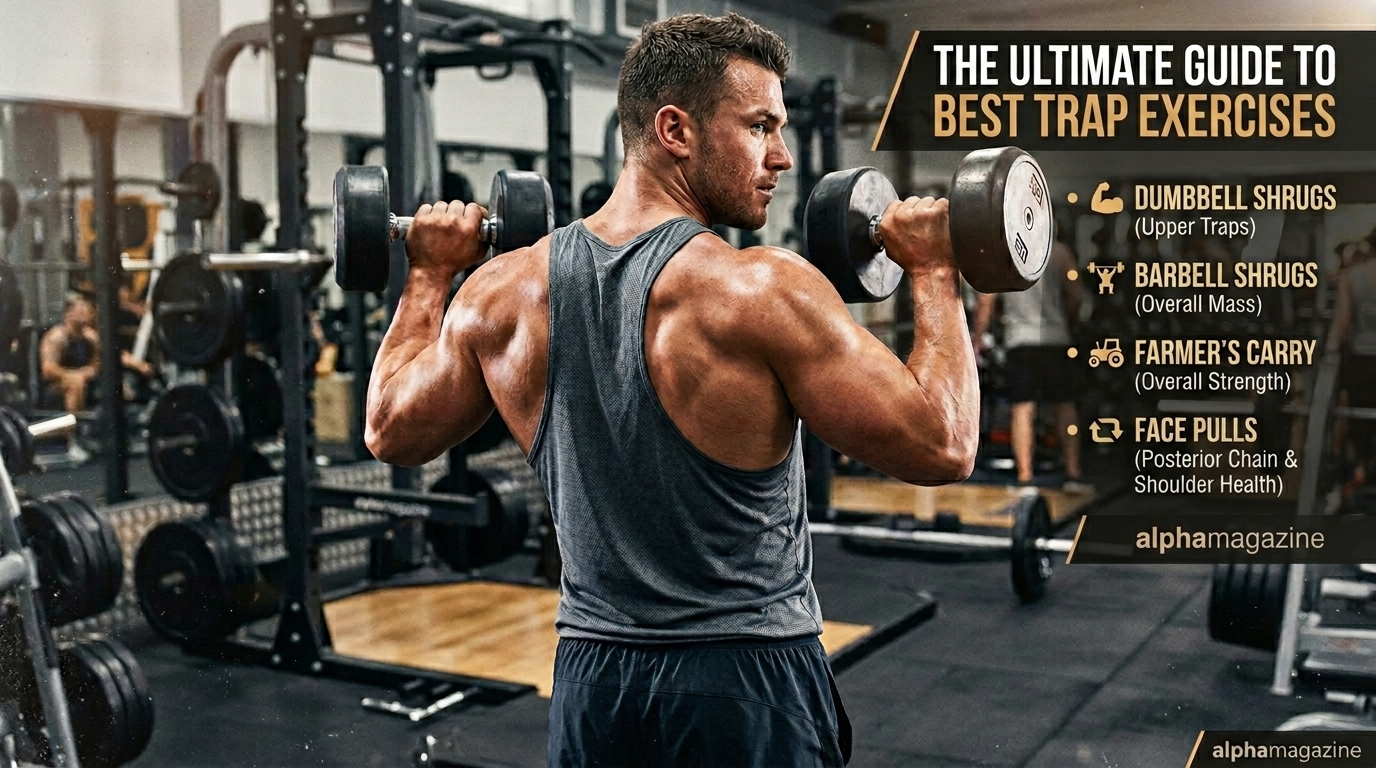
If you have been searching for the best trap exercises to build thickness and strength in your upper back, you are in the right place. The trapezius muscle — commonly called the traps — is one of the most important and most undertrained muscle groups in the body. Strong traps improve your posture, protect your neck and shoulders from injury, and give your upper body a powerful, athletic appearance.
Whether you train at a gym or at home, these seven exercises are the most effective trap movements you can do in 2026 — backed by training science and used by athletes and fitness enthusiasts worldwide.
What Are the Trap Muscles and Why Do They Matter?
The trapezius is a large, diamond-shaped muscle that runs from the base of your skull down to the middle of your back and across to both shoulders. It is divided into three sections — upper, middle, and lower traps — and each section performs different functions.
The upper traps elevate your shoulders and support your neck. The middle traps retract your shoulder blades, keeping your posture upright. The lower traps pull your shoulder blades downward, which is essential for shoulder stability and injury prevention.
Most people only train their upper traps — usually through shrugs — and completely neglect the middle and lower sections. This creates muscle imbalances that lead to poor posture, neck pain, and shoulder injuries over time. The exercises below target all three sections of the trapezius for complete development.
The 7 Best Trap Exercises
- Barbell Shrugs
Barbell shrugs are the most direct upper trap exercise available. Load a barbell with a challenging but manageable weight, hold it in front of your thighs with an overhand grip, and shrug your shoulders straight up toward your ears. Hold for one second at the top, then lower slowly.
The key mistake most people make is rolling their shoulders forward or backward. Keep the movement strictly vertical — straight up and straight down. Three to four sets of 10 to 15 repetitions works well for most people.
- Farmer’s Carries
Farmer’s carries are one of the most underrated trap exercises in existence. Pick up two heavy dumbbells or kettlebells, stand tall, and walk for 30 to 40 metres. The sustained effort of holding heavy weight while walking under control activates your traps, core, and grip simultaneously.
This exercise builds functional trap strength that transfers directly to everyday life and athletic performance. It is also far easier on the joints than heavy shrugs for people with existing shoulder discomfort.
- Face Pulls
Face pulls primarily target the middle and rear traps while also working your rear deltoids and rotator cuff — making them one of the best exercises for shoulder health and posture improvement. Attach a rope to a cable machine at face height, grip both ends, and pull toward your face while flaring your elbows outward.
If you do not have access to a cable machine, resistance bands provide an excellent alternative and are available inexpensively online.
- Dumbbell Rows
Dumbbell rows are a staple back exercise that places significant load on the middle traps when performed correctly. Place one knee and hand on a bench for support, hold a dumbbell in the other hand, and row it toward your hip — driving your elbow back and squeezing your shoulder blade at the top.
The key to maximizing trap activation on this exercise is focusing on the shoulder blade movement rather than just pulling the dumbbell up. Think about retracting and depressing your scapula at the top of each repetition.
- Rack Pulls
Rack pulls are a partial deadlift movement performed from knee height, which places maximum tension on the upper back and traps through the most mechanically demanding range of the movement. Set the safety bars of a power rack at knee height, load the barbell heavily, and perform the top half of a deadlift.
This exercise allows most people to use significantly more weight than a conventional deadlift, which creates a powerful training stimulus for trap growth. It is particularly effective for building the upper trap thickness that creates a powerful looking back and neck.
- Upright Rows
Upright rows involve pulling a barbell or pair of dumbbells from hip height up to chin height, with your elbows leading the movement and flaring outward. This exercise targets the upper traps and lateral deltoids simultaneously.
Use a moderate grip width — slightly wider than shoulder width — and avoid pulling the bar too high, which can cause shoulder impingement in some people. A controlled tempo with a brief pause at the top maximizes trap activation.
- Y-T-W Raises
Y-T-W raises are a bodyweight exercise that specifically targets the lower and middle traps — the most neglected sections of the trapezius in most training programs. Lie face down on a flat bench or the floor, raise your arms into a Y shape, hold for two seconds, lower, then raise into a T shape, hold, lower, and finally raise into a W shape with your elbows bent.
These movements feel light and deceptively simple, but they create significant activation in the lower and middle traps when performed correctly. Include them as a warm-up or as accessory work at the end of your training session.
How to Program Trap Training
For most people, training the traps two to three times per week produces the best results. Include one heavy compound movement such as rack pulls or barbell shrugs in each session, combined with one lighter isolation movement such as face pulls or Y-T-W raises for complete development.
Progressive overload — gradually increasing the weight or volume over time — is the most important factor in trap growth, just as it is for any other muscle group. Track your weights and aim to increase them slightly every one to two weeks.
If you want to track your workouts and get AI-powered training recommendations, check out our guide on the best free AI tools in 2026 — several apps now offer personalized fitness tracking at no cost.
Frequently Asked Questions
Q: How long does it take to build bigger traps? A: With consistent training two to three times per week, most people notice visible improvement in trap size and definition within six to eight weeks. Significant growth typically takes three to six months of progressive training.
Q: Can I train my traps at home without equipment? A: Yes. Y-T-W raises require no equipment at all. Farmer’s carries can be done with household items. Resistance band face pulls are inexpensive and effective. A basic pair of dumbbells opens up the full range of exercises on this list.
Q: Are shrugs enough to build big traps? A: Shrugs alone only train the upper traps. For complete trapezius development and injury prevention, you need exercises that also target the middle and lower traps — such as face pulls, rows, and Y-T-W raises.
Q: How heavy should I go on trap exercises? A: Use a weight that allows you to complete your target repetitions with good form while feeling genuine challenge in the last two to three reps. For shrugs and rack pulls, heavier weight in the 6 to 10 rep range works well. For isolation movements like face pulls, moderate weight in the 12 to 15 rep range is more appropriate.
Q: Do trap exercises help with neck pain? A: Strengthening the traps — particularly the middle and lower sections — can significantly reduce neck and shoulder pain caused by poor posture and muscle weakness. However, if you have existing neck or shoulder injuries, consult a physiotherapist before adding heavy trap training to your routine.
For daily update visit alphamagazine.net