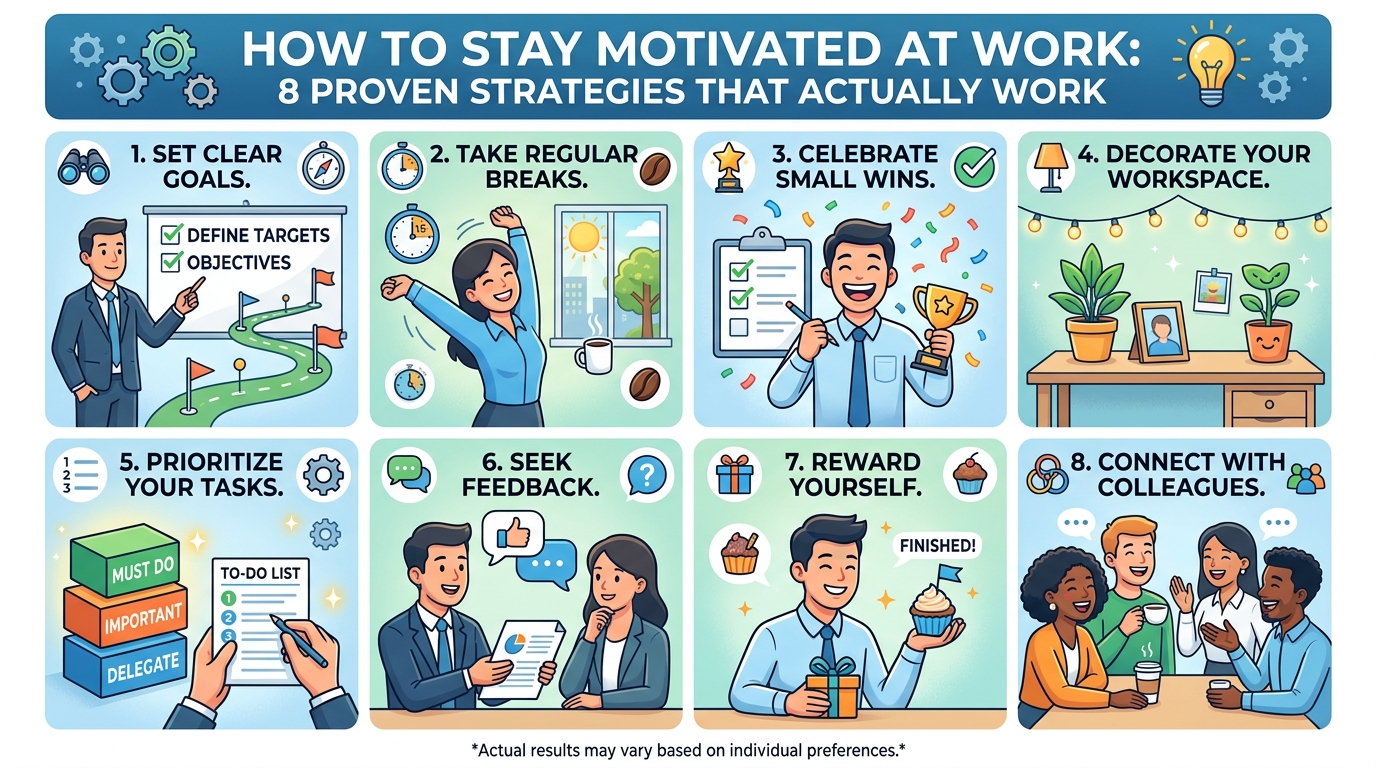
How to Stay Motivated at Work — 8 Proven Strategies That Actually Work
Knowing how to stay motivated at work is one of the most valuable skills you can develop in your professional life. Motivation at work does not arrive automatically — it is built, maintained, and protected through deliberate habits and strategies. Whether you are struggling through a difficult project, feeling stuck in a routine, or simply finding it hard to engage with your work, these eight strategies will help you regain focus and drive.
Why Motivation at Work Disappears
Before addressing how to stay motivated, it helps to understand why motivation fades in the first place. The most common causes are a lack of clear goals, feeling disconnected from the purpose behind your work, insufficient recognition, burnout from sustained overwork, and the absence of progress — the sense that your efforts are not moving anything forward.
Understanding your specific motivation drain helps you apply the right solution. A person who lacks motivation because their goals are unclear needs a different approach from someone who is burnt out from overwork.
- Connect Your Work to a Larger Purpose
The most powerful source of sustained motivation is a genuine connection to why your work matters. This does not require a dramatic sense of mission — it simply means understanding how your contribution connects to outcomes that matter, whether to your team, your organisation, your customers, or your own long-term goals.
When motivation dips, return to this question: why does this work matter? Even in roles that feel routine, the answer usually exists. Finding it — and reminding yourself of it regularly — is one of the most reliable ways to restore drive.
- Set Smaller, Achievable Daily Goals
Large projects and long-term objectives are motivating in theory but demotivating in practice when they feel overwhelming or distant. Breaking your work into smaller, achievable daily goals creates a continuous stream of small wins that fuel ongoing motivation.
At the start of each day, identify two or three specific tasks that you can complete by the end of the day. When you complete them, the sense of accomplishment — however modest — creates positive momentum that carries into the next task. This is the same principle that makes self discipline sustainable over time.
- Manage Your Energy, Not Just Your Time
Most productivity advice focuses on time management. But motivation is more closely linked to energy management. You can have all the time in the world and achieve nothing if your energy is depleted.
Protect your peak energy periods for your most important and challenging work. If you are sharpest in the morning, use that time for tasks that require the most focus and creativity. Reserve administrative tasks, emails, and routine work for lower energy periods. This alignment between task demands and energy levels dramatically improves both output and motivation.
- Remove Friction From Important Tasks
One of the most underappreciated motivation killers is friction — the small obstacles that make starting a task feel harder than it needs to be. A cluttered desk, an unclear brief, missing resources, or an overwhelming to-do list all create friction that drains motivation before you even begin.
Spend ten minutes at the end of each working day preparing for tomorrow. Clear your desk, identify your three priorities, gather any resources you need, and close any open loops that might distract you. Arriving at a prepared workspace with a clear plan removes the friction that stops motivation from converting into action.
- Track Your Progress Visibly
Progress is one of the most powerful motivators available — but it only works if you can see it. When progress is invisible, effort feels pointless. Making progress visible creates tangible evidence that your work is moving forward.
Use a simple tracker — a checklist, a progress bar, a project board — to make your daily and weekly progress visible. Crossing items off a list, moving tasks from in progress to complete, or seeing a project percentage advance all deliver the sense of forward momentum that sustains motivation over time.
- Change Your Environment Periodically
Motivation is partly a function of novelty. The same environment, day after day, gradually becomes less stimulating — which manifests as reduced motivation and engagement. Changing your working environment periodically counteracts this effect.
Work from a different location occasionally. Rearrange your desk. Change the order in which you tackle your daily tasks. These small environmental changes introduce enough novelty to re-engage your attention without disrupting your core routines.
- Protect Your Recovery Time
Sustained motivation requires adequate recovery. Working longer hours and taking fewer breaks does not increase output over time — it accelerates the depletion of the mental and physical resources that motivation depends on.
Take genuine breaks during the working day — away from screens, away from work-related thinking. Protect your evenings and weekends as recovery time rather than overflow time for unfinished work. Sleep is non-negotiable. The people who sustain high motivation over long careers are almost always the ones who take recovery as seriously as they take work.
- Dress Intentionally for Work
The connection between how you dress and how you perform is well-documented in behavioural psychology. Wearing clothes that make you feel competent and professional — what researchers call enclothed cognition — measurably improves focus, confidence, and motivation.
This applies equally to remote workers. Getting dressed properly for a working-from-home day, rather than staying in casual clothes, is a simple and effective way to signal to your brain that it is time to perform. For practical guidance on building a wardrobe that supports your professional confidence, read our complete guide on what to wear to a job interview.
Frequently Asked Questions
Q: How do I stay motivated when my work feels meaningless? A: Start by identifying whether the meaning gap is in the work itself or in your connection to it. If the work genuinely does not align with your values or goals, that is worth addressing seriously — possibly including a career conversation or change. If the connection to meaning simply needs rebuilding, returning to the purpose behind your role and the impact it has on others is the most effective starting point.
Q: Is it normal to lose motivation at work? A: Yes — entirely normal. Motivation naturally fluctuates for everyone, regardless of how much they enjoy their work. The difference between people who sustain high performance and those who do not is not that the former never lose motivation — it is that they have systems and strategies to restore it when it dips.
Q: How can I stay motivated when working from home? A: Structure and environment are the key factors for remote workers. Maintain consistent working hours, create a dedicated workspace separate from your relaxation areas, dress intentionally for work, and build in regular breaks and social interaction to counteract the isolation that often underlies remote motivation challenges.
Q: What is the fastest way to regain motivation at work? A: Complete one small task immediately and completely. The act of finishing something — however minor — triggers a dopamine response that creates momentum. Once that momentum exists, directing it toward your next priority becomes significantly easier.
Q: Can motivation be built as a habit? A: Yes. While motivation is partly an emotion that fluctuates naturally, the habits and systems that support motivated behaviour can absolutely be built deliberately. The strategies in this article are all habit-based — which means their effectiveness increases the longer and more consistently you apply them.